
Stéphanie Vandentorren, a public health epidemiologist, is committed to understanding the links between social inequalities, precariousness and mental health. Her research, which covers health crises as well as terrorist attacks and the living conditions of marginalized populations, reveals the mechanisms by which the social and economic environment shapes psychological vulnerability. For the epidemiologist, a better understanding of post-traumatic disorders requires a systemic approach in which the social determinants of health play a central role.
A researcher committed to public health and social epidemiology

After completing an internship in public health, Stéphanie Vandentorren specialized in infectious and then environmental epidemiology, before broadening her field of expertise to include social inequalities in health. " It's a cross-cutting issue that cuts across the whole of society, and concerns infectious and environmental diseases, chronic pathologies and mental health in equal measure," she explains.

She was soon involved in large-scale cohort studies, such as the ELFE project - the first national study dedicated to tracking children. "I worked for five years as part of an INED team to build this vast cohort, which aimed to analyze all aspects of child development.
His work has led him to collaborate with researchers in sociology, demography, epidemiology and toxicology, while he has become aware of the importance of living conditions on health, particularly through the notion of the exposome.
What is the exposome?
Proposed by epidemiologist Christopher Wild in 2005, the exposome refers to all the exposures to which a person is subjected throughout his or her life, from conception to death. This includes environmental, social and behavioral factors that interact with the genome and influence health.
The influence of social factors on children's development led her to deepen her understanding of social vulnerability, when she joined theObservatoire du Samu social de Paris. It was here that she came face to face with the psychological repercussions of exile and exclusion. "Migrant women accumulate several factors of fragility: trauma in the country of origin, violence on the migration route and precarious living conditions in the host country". This experience is gradually shaping the focus of her research: understanding how precariousness and living conditions shape the risk of post-traumatic stress disorder.
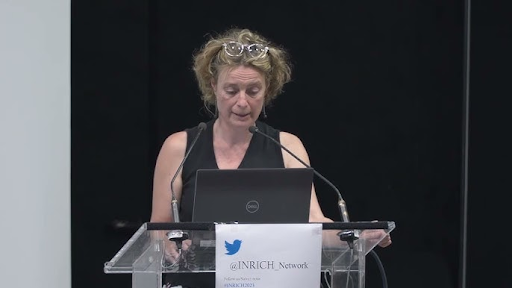
Stéphanie Vandentorren speaking at the INRICH Workshop in 2023 on social inequalities in children's health.
A trajectory marked by health crises and terrorist attacks
The epidemiologist's research takes on a new dimension when she is confronted with the psychological effects of health crises and terrorist attacks. As head of a regional unit at Santé Publique France, Stéphanie Vandentorren is involved in assessing the health impacts of major crises such as the 2003 heatwave, emerging epidemics such as Ebola, the COVID-19 pandemic, and the 2015 attacks in the Paris region.
During the 2003 heat wave, she emphasized the importance of the environment and social support as protective factors for health and mortality. More recently, during the COVID-19 crisis, her work highlighted the impact of living conditions on the risk of becoming infected, developing a severe form of the disease and dying from it, as well as the importance of the impact on mental health, particularly in children and adolescents.
It was during the January 2015 attacks that she focused more specifically on psychotrauma, notably as part of the I.M.P.A.C.T.S study, which she piloted in the Île-de-France region. The aim? To assess the psychological and social impact of the attacks on those directly or indirectly exposed, and to analyze their care pathways in order to identify the factors that encourage or hinder their recourse to psychological support. The study identified the psychological trajectories of victims, witnesses and responders, and thus highlighted the multiplicity of reactions to trauma.
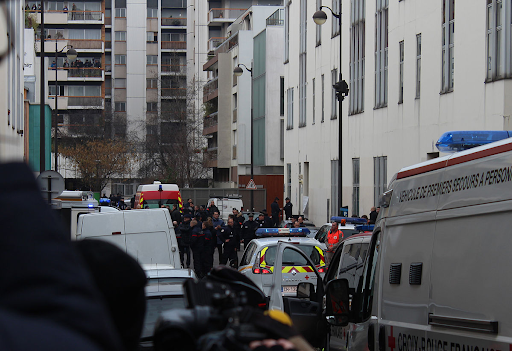
View of the area of the 11th arrondissement (rue Nicolas Appert) closed to onlookers by police after the shooting at Charlie Hebdo headquarters, taken with the help of LCP journalist Jérémie Hartmann.
"We've seen various impacts, which also affect witnesses, local residents and a wider circle of people present in the perimeter of the events, even without a direct threat."
She also observes that some people develop symptoms immediately, while others develop them later, and that this has an impact on their family, social and professional life. This observation underlines the importance of extending care to different populations, and of continuing it over time. She also stresses the need for training for healthcare professionals: "Many miss out on the psychosomatic manifestations of trauma, not least because they are not always trained to identify these symptoms and question patients appropriately."
A systemic look at trauma and public health
Stéphanie Vandentorren insists on the need to integrate the human and social sciences into the study of psychotrauma. "Epidemiology provides essential data, but it is by putting it into dialogue with sociology, anthropology and psychology that we can better understand how individuals go through and overcome trauma."
She believes that only an interdisciplinary approach can refine our understanding of trauma mechanisms and effectively guide public mental health policies.
For the epidemiology researcher, mental health cannot be isolated from the environment and living conditions. " We need to tackle the causes of the causes: the environment, work, housing, precariousness, mobility and pace of life, access to health services, culture and leisure, social and parental interaction and support; but also, upstream, socio-economic policies and societal values (inclusion or discrimination, stigmatization)..." Her approach is resolutely multidisciplinary and systemic, inspired by global health models. The epidemiologist advocates strengthening prevention from the earliest age.
"Investing from childhood, upstream of the healthcare system, in psycho-social skills and education, but also acting on the healthcare system by strengthening child psychiatry and, more generally, early support, means preventing rather than repairing."
Finally, she advocates a more participatory approach to health and care, which includes those affected in the very design of systems. "We can't think about trauma care without including those who experience it.
Advice for young researchers
His advice to young researchers? "Dare to think outside the box. Psychotrauma, like public health, is a vast field that benefits from crossing and renewing perspectives."
To find out more :
On the attacks and psychotrauma
- Vandentorren, S., Pirard, P., Sanna, A., Aubert, L., Motreff, Y., Dantchev, N., ... & Baubet, T. (2018). Healthcare provision and the psychological, somatic and social impact on people involved in the terror attacks in January 2015 in Paris: cohort study. The British Journal of Psychiatry, 212(4), 207-214. https://pubmed.ncbi.nlm.nih.gov/29557760/
- Vandentorren, S., Pirard, P., Sanna, A., Aubert, L., Motreff, Y., Dantchev, N., ... & Baubet, T. (2018). Healthcare provision and the psychological, somatic and social impact on people involved in the terror attacks in January 2015 in Paris: cohort study. The British Journal of Psychiatry, 212(4), 207-214. https://www.santepubliquefrance.fr/en/mental-health-care-utilization-by-first-responders-after-paris-attacks
- Vandentorren, S., Sanna, A., Aubert, L., Pirard, P., Motreff, Y., Vuillermoz, C., Lesieur, S., Chauvin, P., Dantchev, N., & Baubet, T. (2018). IMPACTS study: Investigation of post-attack traumatic events and therapeutic and supportive care for people involved in the January 2015 attacks in Île-de-France. Bulletin Épidémiologique Hebdomadaire, (38-39), 738-746. Santé publique France.https://www.santepubliquefrance.fr/maladies-et-traumatismes/stress-post-traumatique/documents/article/etude-impacts-investigation-des-manifestations-traumatiques-post-attentats-et-de-la-prise-en-charge-therapeutique-et-de-soutien-des-personnes-imp
- Vandentorren, S., Sanna, A., Aubert, L., Pirard, P., Motreff, Y., Dantchev, N., & Baubet, T. (2015). IMPACTS cohort study: First stage (June-October 2015). Investigation of post-attack traumatic manifestations and therapeutic and supportive care of people involved in the January 2015 attacks in Île-de-France. Santé publique France. https://www.santepubliquefrance.fr/docs/etude-de-cohorte-impacts.-premiere-etape-juin-octobre-2015
On precariousness and the mental health of vulnerable populations
- Vandentorren, S., Huber, F. and Queneau, C. (2024). The impact of living conditions in the host country on the mental health of immigrants. Rhizome, N° 90-91(2), 9-10. https://shs.cairn.info/revue-rhizome-2024-2-page-9?lang=fr
- Vandentorren, S. (2024). Social determinants and access to health services. La Revue de l'Infirmière, 73(303), 16-18. https://doi.org/10.1016/j.revinf.2024.07.003