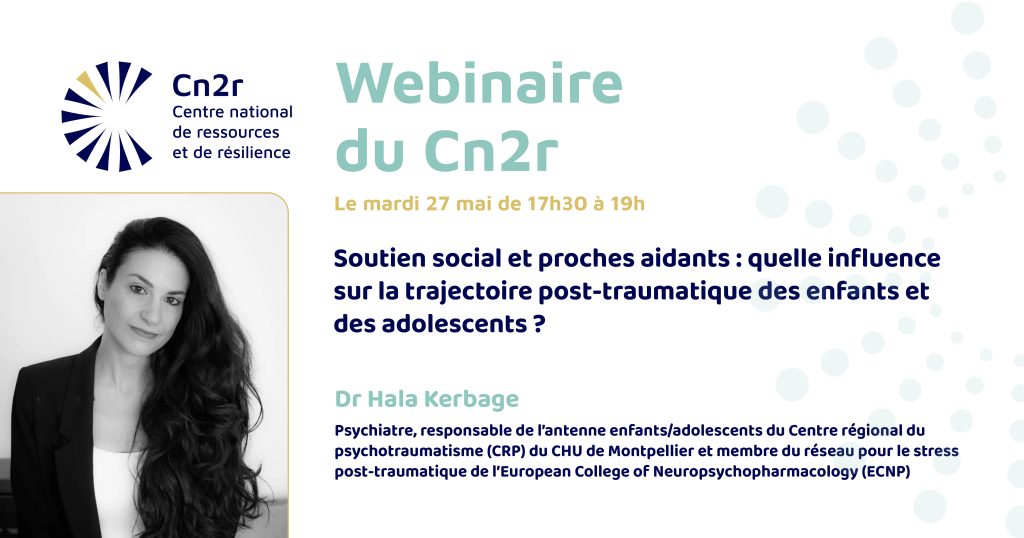
Hala Kerbage, a psychiatrist at Montpellier University Hospital, coordinates the children's and teenagers' unit of the Centre régional du psychotraumatisme. Her work combines clinical practice, research and training, with a particular focus on the family and social resources of children and adolescents affected by post-traumatic stress disorder.
"We are not born resilient, we become resilient".

In Montpellier, Hala Kerbage oversees the intake, assessment and care of children and adolescents exposed to traumatic events, with a multidisciplinary team. The assessment proposed is standardized and not limited to the identification of post-traumatic symptoms, but also includes an evaluation of the risk and protective factors specific to the child and his or her environment.
She distinguishes two axes in the intervention: work with the parents, focused on detecting post-traumatic symptoms in the parents themselves, and reinforcing their support skills for the child; and work with the child to identify post-traumatic symptoms and pass on, with the help of the adult, age-appropriate regulation techniques in the first instance, followed by specialized therapies validated for post-traumatic stress disorder in the second.
"You're not born resilient, you become resilient", she sums up. This idea guides all care, from psycho-education or stabilization sessions to therapies, depending on what is deemed relevant after assessment. Social support, in particular, is the subject of concrete work with families. The aim is not just to tell them to surround themselves, but to help them identify resource people and places, and re-establish useful links, making social support a therapeutic objective.
Learning not to know for others
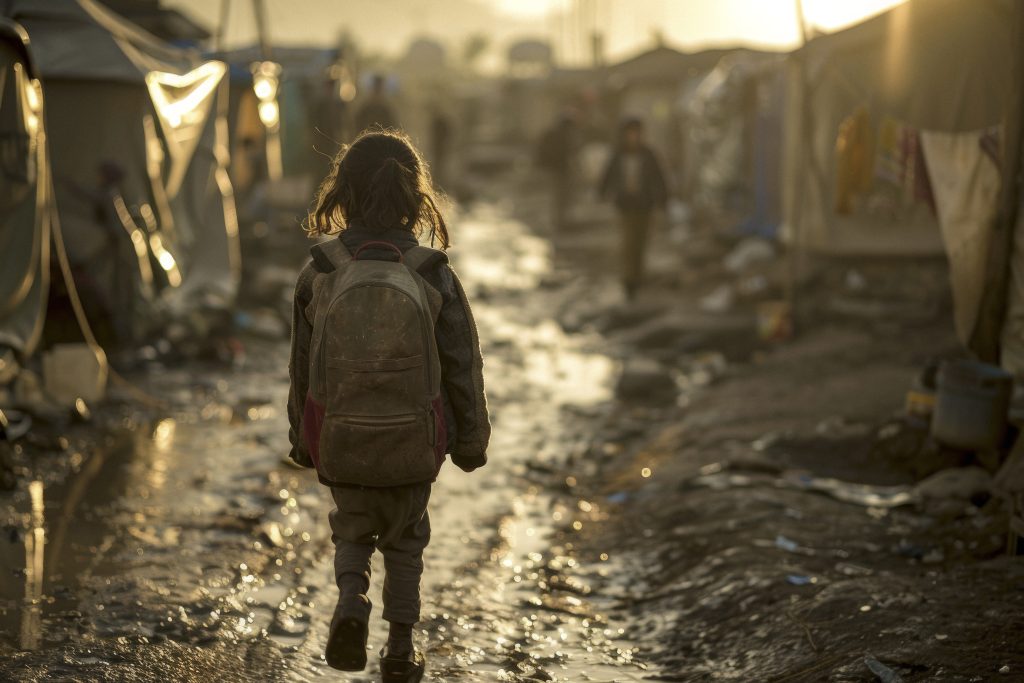
Before joining the Montpellier University Hospital, Hala Kerbage worked for several years in Lebanon, notably with international NGOs. She worked with Syrian refugees who had survived torture camps, displaced Palestinians, and carried out a mission in Erbil, Iraq, with Yezidi women who were victims of genocide. These experiences have led her to question certain top-down postures.
"After certain horrors, you can't just come in and say: this is the therapy you need." She insists on the need to listen to what people have experienced, what they want, what they really need. Some people refuse to be called traumatized, and define themselves as survivors, sometimes as resisters. For her, this reflects neither a lack of understanding nor a misunderstanding of psychiatry, but another way of making sense of experience.
Thinking of care in terms of the link
From this experience stems a conception of care guided by a concern for humility towards patients. For her, expertise cannot be dissociated from attention to experience. She insists on giving people the power to influence their own lives. In the aftermath of trauma, what counts is preserving agentivity. "What hurts the most is feeling powerless. Patients must remain authors of their own history."
Early intervention focused on children and their families
Hala Kerbage also devotes part of her time to research. She is currently piloting a randomized controlled trial of an early post-trauma intervention, which can be implemented within three months of exposure to a traumatic event, structured around two axes: strengthening parent-child communication, parental support and parental mental health, and acquiring skills to stabilize the child's post-traumatic symptoms according to age, in coordination with the parents. The originality of this intervention lies in the fact that it targets not only the child, but also the parents, and the impact of the traumatic event on the parents. She will present the principles of this approach during the webinar organized by Cn2r on May 27.
"It's not specialized re-exposure therapy because we're still at an early stage, but a way of regaining control over symptoms, and working on protective factors to prevent the onset of post-traumatic stress disorder after traumatic exposure."
"Psychotrauma must be everyone's business".
"Psychotrauma cannot be the preserve of experts," she stresses. In her view, every healthcare professional must be able to accept a patient's word, validate it, provide information on symptoms and support families in the initial stages. This necessary common culture of care implies training general practitioners, midwives and PMI caregivers, and opening up validated therapies to other professions, such as trained nurses.
A striking read, between memory and violence

Among the works that count for her, Hala Kerbage cites Anima, by Wajdi Mouawad. A striking novel, as much for its form - each chapter is told from the point of view of an animal - as for what it deals with: violence, memory, identity. "When you work in trauma, you sometimes hear things that are so hard that you wonder how people cope. This book doesn't give answers, but it goes along with that question."
Of Lebanese origin, she was also struck by what the text says about silence: "I grew up in a country marked by war, but where this war is almost never recounted. There's a kind of collective amnesia. And this silence continues to affect people.
" Resilience is not an inherent trait "
In the coming years, Hala Kerbage aims to consolidate the operation of the Regional Center for Child and Adolescent Psychotrauma, based on rigorous assessment tools, structured care and the development of specific training courses. She is working to disseminate validated therapies, such as prolonged exposure, and to strengthen the skills of front-line professionals, particularly in stabilization and psycho-education.
But for her, thinking about resilience means looking beyond the individual. "We can't put the burden of remission solely on the child or his or her family. We must also be able to say that social inequalities, living conditions and systemic violence have an impact." For her, improving access to care is not enough. We also need to be able to name the social, economic and political factors that contribute to suffering. "We can't put the responsibility for remission solely on the shoulders of the individual, especially the child. We also need to be able to say that social inequalities, precariousness and systemic violence have an impact."