

Adverse Childhood Experiences (ACEs) have become a central concept in public health research. First conceptualized in the 1990s, they initially encompassed ten types of adverse childhood experience. Since then, their scope has broadened, raising questions about the relevance and use of the concept for collective health promotion and improving individual care. How has the concept evolved, and what can we say about it today? How does it relate to post-traumatic stress disorder ?
Playback time: 8 minutes
A concept that has evolved over time
ACEs are a set of negative childhood experiences associated with deleterious consequences on physical and mental health in adulthood. They include various forms of abuse (physical, emotional, sexual), neglect and family dysfunction.
Michelle Kelly-Irving, social epidemiologist at Inserm, explains: "Originally, the concept was structured around specific areas such as physical abuse or neglect, but it has gradually broadened to include dimensions such as socio-economic conditions."
The seminal study conducted by Felitti and colleagues in 1998 revealed that repeated exposure to ACEs significantly increases the risk of developing risky health behaviors (e.g., substance abuse), chronic illnesses and psychiatric disorders. Today, research confirms that people who have undergone four or more ACEs have a higher probability of developing somatic and psychic pathologies. This risk is found for PTSD, anxiety disorders and depression.
Long considered as a simple accumulation of risk factors, "these experiences are now integrated into more complex models that take into account life trajectories and interactions with the social environment", moderates epidemiologist Michelle Kelly-Irving. Rather than being a simple, isolated indicator, ACEs are now seen as one element among others in the understanding of health inequalities.
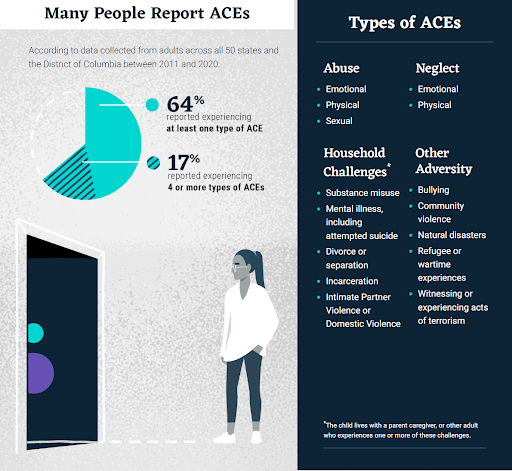
According to the Centers for Disease Control and Prevention (CDC), 64% of adults report having had at least one adverse childhood experience, and 17% report having had at least four types. These figures highlight the frequency of these experiences and their potential impact on health.
Typology of adverse childhood experiences (ACEs). Source : CDC
"ACEs shape the stress response and sculpt the brain".
Research shows that adverse childhood experiences (ACEs) profoundly modify the stress response and can promote the emergence of PTSD, particularly complex PTSD. Neurobiologically speaking, early and repeated exposure to stress disrupts the maturation of brain circuits involved in emotion regulation, and deregulates the stress axis. The cerebral amygdala, a complex grouping of several nuclei in each cerebral hemisphere, is an important structure in emotional processing.
These structures are a good example of the interplay between ACEs, brain development and emotional regulation: depending on the timing of adversity, amygdala development can be altered, leading either to hyper-reactivity to stressful stimuli, or, conversely, to a blunting of the emotional response.
This developmental inscription shows that it's not just a question of the presence or absence of these experiences. What seems to matter is their accumulation, as well as moments of adversity. On average, people exposed to ACEs have a higher risk of experiencing dysregulation of their stress response system, as if each new exposure weakened them, with a greater risk depending on the period of development when adversity occurs.
"The stress response system is shaped by childhood experiences. Repeated activation of cortisol can unbalance the neural circuits involved in emotion regulation," explains Marion Trousselard, a doctor and researcher in stress physiology.
The neuroscientist also points out that the brain, which develops until adulthood, is particularly vulnerable to these disturbances. Certain structures, such as the amygdala, only mature gradually: "If a child is exposed to severe neglect at the age of two, one of the critical moments for the development of amygdala function, the amygdala may become hyper-reactive. But repeated exposure to trauma later in childhood can lead to atrophy of this structure, subsequently limiting the ability to feel or express emotions."
In addition to these brain alterations, ACEs also influence the construction of social and emotional networks. Marion Trousselard highlights their role in the formation of social cognition : "An insecure attachment, which is built up from the very first interactions with the caregiver, will shape the way the individual perceives and interprets the emotions of others. If this perception is biased, stress can be activated in maladaptive ways, contributing to increased vulnerability to subsequent traumatic events."
"A child who is surrounded is a child who is better protected".
Certain conditions can mitigate the effects of ACEs. Social support plays a central role, but is not limited to the family circle. Access to education, emotional stability and the ability to regulate one's emotions are all factors that influence how an individual reacts to early adversity.
A recent study shows that people who have been able to count on a supportive figure, be it a parent, teacher or loved one, develop greater resilience in the face of traumatic childhood experiences. In adulthood, stable, secure relationships also help limit the impact of ACEs on mental health.
"A caring environment not only protects psychologically, it also acts on the physiology of stress. An individual who feels supported will have a more balanced hormonal response, which limits the deleterious effects of chronic stress," explains Marion Trousselard.
However, these protective factors are not evenly distributed across the population. Public health research emphasizes the influence of economic and social context: a child living in a precarious environment will find it harder to mobilize social resources, and this can have the effect of accentuating the deleterious effects of ACEs.
The Centers for Disease Control and Prevention (CDC) promotes a comprehensive approach to limiting the effects of ACEs, emphasizing the need for collective and structural action. In an educational video, the agency illustrates how ACEs influence health across the lifespan, and proposes five strategies for reducing their impact, including strengthening economic support for families and improving parenting skills.
"A useful tool, but handle with care".
While research on ACEs has shed light on the effects of adverse childhood experiences on health in adulthood, their use should not be simplistic. " Witnessing an argument or experiencing serious violence does not have the same impact, yet these situations are sometimes counted in the same way ," says Michelle Kelly-Irving.
The concept is designed for public health research, not individual diagnosis. " Identifying people without having solutions to offer them can generate more distress than benefits," she warns. In some contexts, such as in the USA, ACE scores are used to justify judicial decisions, for example to assess the dangerousness of an individual or the placement of a child, which she deems inappropriate.
The challenge is not to mechanically account for adversity, but to grasp its complexity and integrate what are now recognized as protective factors into individual care. As Marion Trousselard points out, "understanding how chronic stress, which sets in from childhood in the presence of repeated adversity, modifies brain physiology is a major advance, but we mustn't confine individuals to a biological determinism."
Rather than locking ACEs into a rigid framework, it's better to take a measured approach, taking into account individual trajectories, the impact of context and the limitations inherent in current assessment tools.
- Buchanan, M., Walker, G., Boden, J. M., Mansoor, Z., & Newton-Howes, G. (2023). Protective factors for psychosocial outcomes following cumulative childhood adversity: Systematic review. BJPsych Open, 9(6), e197.
- Crede, M., Tynan, M., Harms, P. D., & Lester, P. B. (2023). Clarifying the association between adverse childhood experiences and postdeployment posttraumatic stress disorder symptom severity: A meta-analysis and large-sample investigation. Journal of Traumatic Stress, 36(4), 700-711.
- Santé publique France. (2019). State of scientific knowledge on childhood adversity. Health in Action, (447), 1-22.
- Tarquinio, C. L., Trousselard, M., Rotonda, C., & Tarquinio, C. (2024). Descriptive models of AdverseChildhood Experiences and implications for research: State of the art and perspectives. Annales Médico psychologiques, revue psychiatrique, 182(3), 242-250.
- Relationship of childhood abuse and household dysfunction to many of the leading causes of death in adults. The Adverse Childhood Experiences (ACE) Study-PubMed(n.d.).